The tinies are very small Linux systems that I build from source against the musl C library. I use them every day to create virtual clusters in seconds, to test kernels, filesystems and storage, and as a rescue system for my own machines. Despite the size they have a lot inside: QEMU/KVM, ZFS, NFS, ksmbd (SMB3 server in the kernel), ntfs3, mdadm, ddrescue, iperf3, a text web browser, terminal multiplexers and more.
Current version: kernel 7.3.6 (26 November 2026).
Flavours
| Image | Size | What it is |
|---|---|---|
| tinyP.img | 23 MB | the smallest one, basic tools, runs entirely in RAM |
| tinyZ.img | 39 MB | the most complete: QEMU, VDE, sqlite, NVMe, NFS and ZFS, runs entirely in RAM. It is also my rescue system |
| tinyN.img | 140 MB | the same software as tinyZ on a writable disk (NORAM): changes are kept and it uses the least RAM |
Checksums: SHA256SUMS.
The images are ready-to-boot disks (MBR + extlinux). The quickest way to try one:
qemu-system-x86_64 -enable-kvm -m 512 -drive file=tinyZ.img,format=raw -nic user
They also boot from a USB stick: dd the image onto it.
vmo: virtual clusters in seconds
vmo (formerly vmstart) is the tool that turns the tinies into a lab. It boots and manages a set of QEMU/KVM VMs on a shared bridge, and it is included in every image:
- create and destroy clusters of VMs in seconds (
vmo start -image tinyZ.img -count 3); - hotplug disks, NICs, CPUs, RAM and USB devices into running VMs;
- live migration between nodes, also with nested virtualisation;
- point-in-time images of a running disk-based VM;
- run commands on all VMs over vsock, without network or SSH;
.cmdfiles: one text file drives the host and every VM, so a whole test (a MooseFS or LXD cluster, a ZFS replica, a RAID…) can be rebuilt with one command.
Since September 2026 vmo is a single static C binary: the same file runs on a normal host and inside the tinies. There are some (older) videos in Screencasts.
What’s inside
Everything is compiled from source, statically where possible. Some highlights:
- BusyBox (latest from git) with our patch for eCryptfs:
ecryptfs_mount [-r] LOWER MNTmounts an encrypted directory with a passphrase, no extra tools needed.whoandlastwork for console logins. - links text browser with CA certificates (it works best on server-rendered sites).
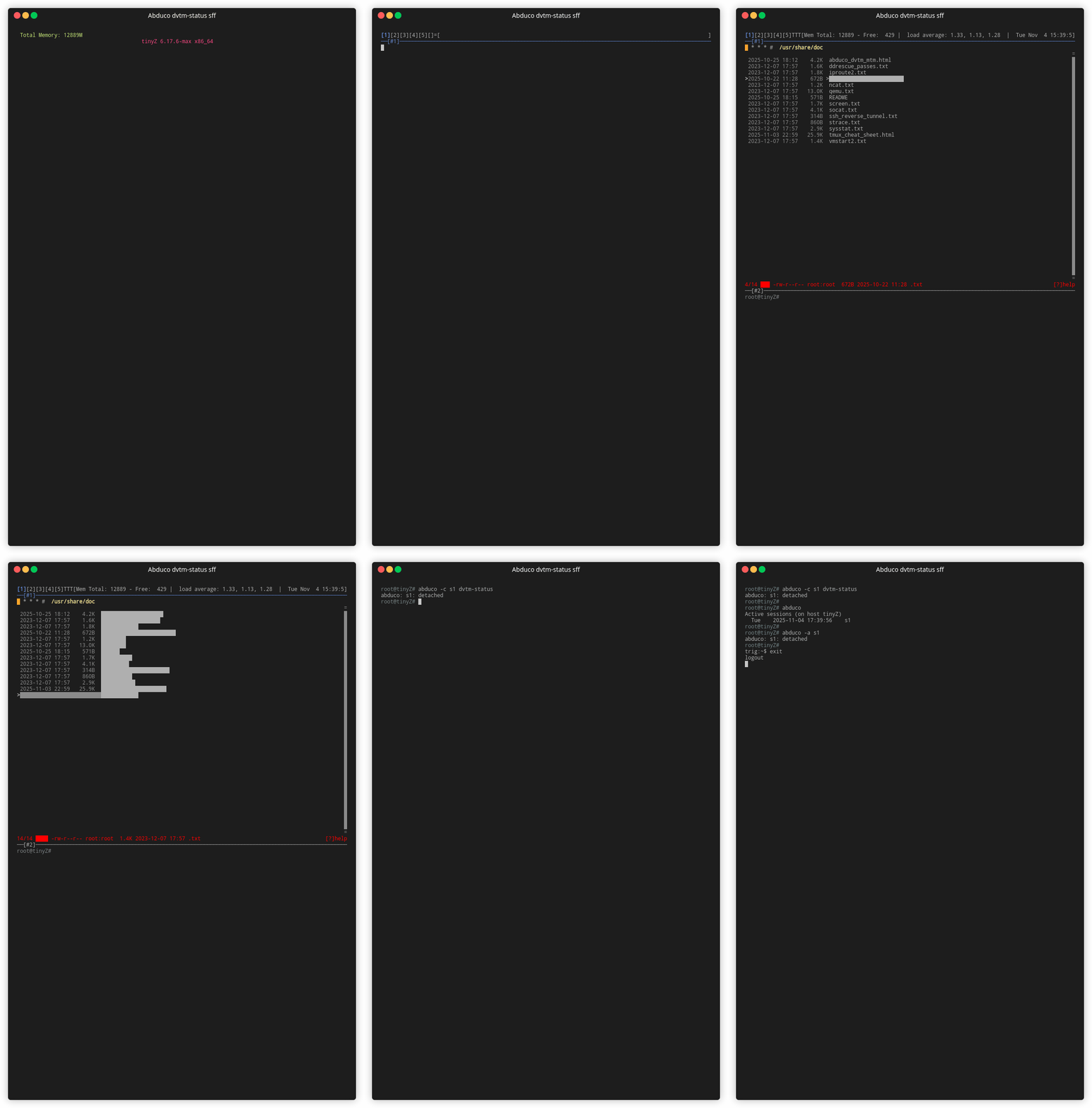
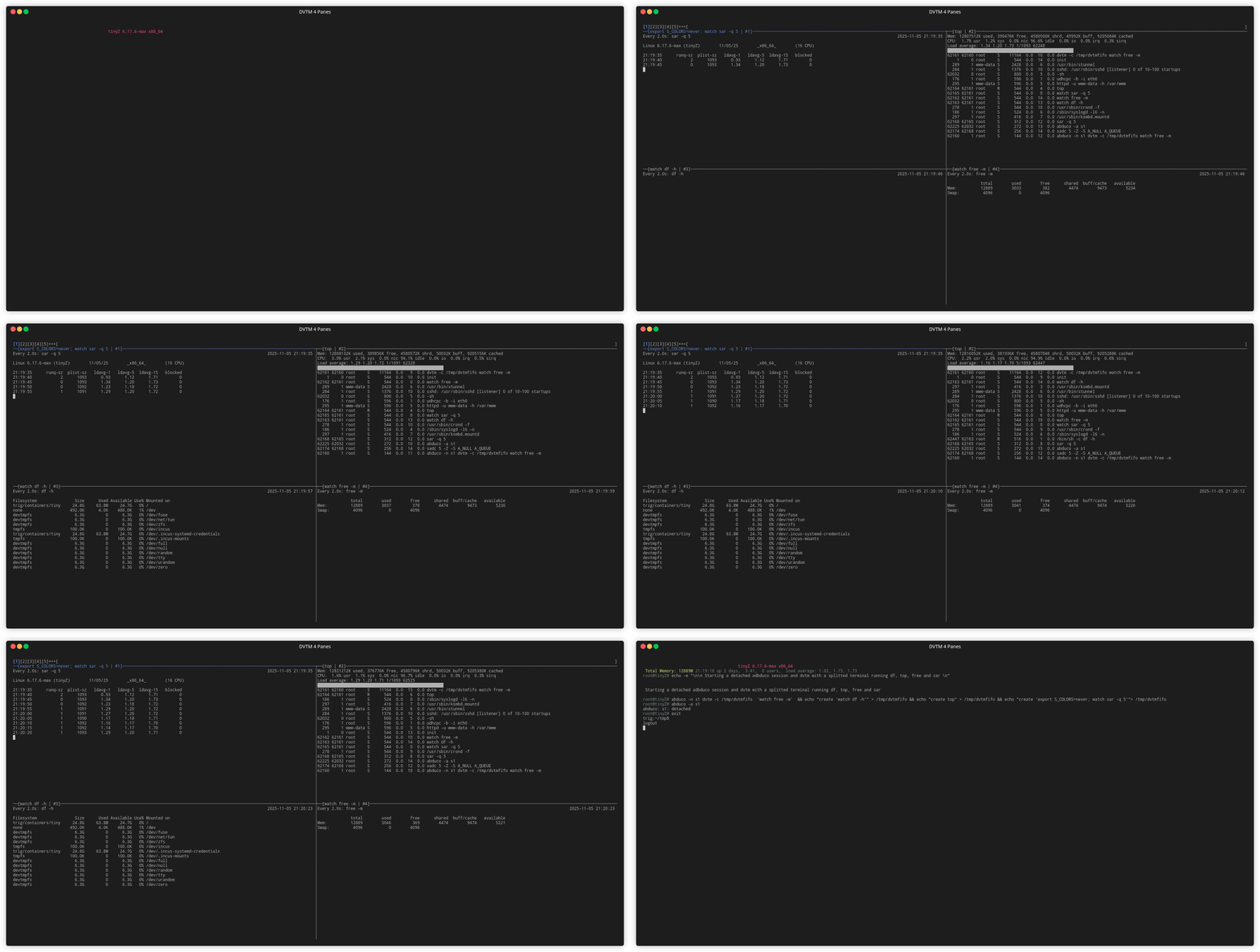
- abduco + dvtm, a simpler alternative to tmux or screen, and mtm, the smallest useful terminal multiplexer. A short guide is inside the tinies:
links /usr/share/doc/abduco_dvtm_mtm.html. Examples: abduco, dvtm. - sff file manager (press
?for help), static xz.
Changelog
- Nov 2026 — kernel 7.3.6. All the scripts in
/etc/init.drewritten;lynxreplaced bylinks+ CA certificates; BusyBox 1.39 with the eCryptfs applet and workingwho/last;vmorewritten and revised. tinyO and tinyQ discontinued. - Sep 2026 —
vmobecomes a static C binary (before: shell script, then Go). - Jun 2026 — all images rebuilt with a new builder: dynamic ext4 images booted by extlinux, no more fixed-size templates.
- Apr 2026 — kernel 7.0.1, everything rebuilt from source; added abduco, dvtm, mtm, sff and static xz.
- 2023–2025 — periodic rebuilds with the latest kernel and BusyBox (6.5 → 6.17), ZFS 2.2, ksmbd 3.4.8, mdadm 4.3. In Sep 2023 the images were renamed: tinyzfs → tinyZ, tinyPQ → tinyQ, tinyNR → tinyN.
- 2019–2022 — first public versions; kernels 4.20 → 6.0, ksmbd and ntfs3 support (kernel 5.15),
vmstartgains.cmdfiles, migration and nested virtualisation.